Computational Biophysics and Bioinformatics
Professor Emil Alexov Group

DelPhi Software Management and Development
Supported by grants from NIGMS/NIH and NSF, including R01 GM093937, R35 GM151964, and NSF DMS-1812930
Electrostatic interactions are central to biomolecular structure, recognition, stability, assembly, and function. They influence protein folding, ligand binding, enzymatic catalysis, nucleic-acid organization, protein-protein interactions, and many other processes that are important in biophysics, drug discovery, and biomolecular modeling. Because biological macromolecules exist in water, often at nonzero ionic strength and with highly irregular shapes, analytical solutions of the Poisson-Boltzmann equation are generally not available. Numerical methods are therefore required to calculate electrostatic potentials, reaction-field energies, ion distributions, and related properties.
DelPhi is one of the foundational Poisson-Boltzmann equation solvers for biomolecular electrostatics. Originally developed in Professor Barry Honig’s laboratory in 1986, DelPhi introduced a robust finite-difference framework that has been widely used by the biomolecular modeling community. Its long-standing popularity comes from its speed, accuracy, ability to handle complex molecular shapes, and capacity to perform calculations on very large grids. The latest DelPhi C++ release, DelPhi C++ v8.5.0, is available from the DelPhi C++ release page and includes OpenMP and MPI options, distributed-memory capabilities, multiple dielectric models, advanced boundary conditions, Gaussian-based smooth dielectric functions, zeta-potential calculations, salt modeling approaches, and output of electrostatic potential maps, dielectric distributions, and related numerical quantities.
The DelPhi ecosystem has continued to expand beyond the core Poisson-Boltzmann solver. Related tools include DelPhiPKa for pKa prediction, DelPhiForce for electrostatic force calculations, BION/BION-2 for ion-binding site prediction, and additional tools for mutational and biomolecular electrostatics analysis. Together, these resources support applications ranging from electrostatic potential mapping and solvation-energy calculations to protein-protein interactions, protein-DNA systems, ion effects, disease-associated mutations, and large biomolecular assemblies.
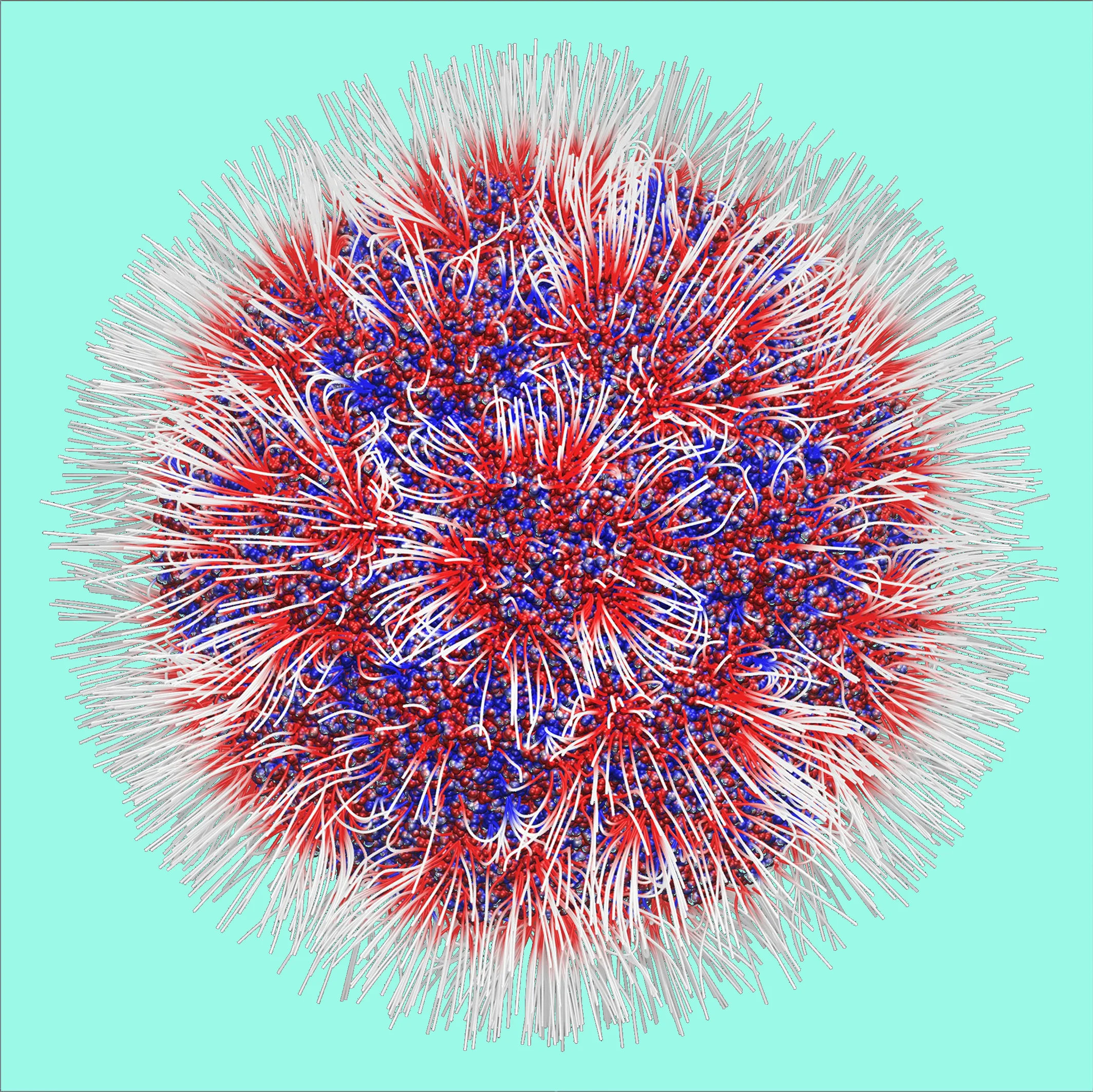
A recent development in this ecosystem is pyDelPhi. It is a Python/Numba-based Poisson-Boltzmann framework designed to preserve the established DelPhi numerical foundation while improving extensibility, reproducibility, and scalability on modern heterogeneous hardware. pyDelPhi supports traditional and Gaussian/Super-Gaussian dielectric models; linearized, nonlinear, and regularized Poisson-Boltzmann formulations; single- and double-precision execution; CPU parallelization; and NVIDIA GPU acceleration through a CUDA backend. Here, regularized Poisson-Boltzmann refers to an alternate PB formulation that analytically handles the source singularity of the super-Gaussian PBE. In published benchmarks, pyDelPhi reproduced DelPhi reaction-field energies within small fractions of a percent across curated protein, protein-protein, and protein-DNA datasets, while providing substantial GPU acceleration for large systems. The framework also introduces a cuboidal grid-box option that can reduce memory usage and runtime for elongated or anisotropic biomolecular systems. In a large-scale benchmark on the hepatitis B viral capsid, pyDelPhi enabled billion-grid-point Poisson-Boltzmann calculations with close numerical agreement to DelPhi and major reductions in wall-clock time. The pyDelPhi source code, installation instructions, examples, and future updates are available through the project GitHub repository.
Together, DelPhi and pyDelPhi provide continuity between the long-standing DelPhi electrostatics framework and its modern implementation. The established DelPhi suite remains available for ongoing studies, legacy workflows, and historical benchmarking, while pyDelPhi serves as the forward-looking platform for new development, extended capabilities, high-performance computing support, and reproducible workflows in computational biology, biophysics, and biomedical research.
For background on the established DelPhi ecosystem, users may consult the 2019 Journal of Computational Chemistry DelPhi suite review and the DelPhi tutorial paper in Living Journal of Computational Molecular Science, which describes the earlier DelPhi suite, workflows, and associated resources. For new work and future development, users are encouraged to use pyDelPhi, described in the 2026 Journal of Chemical Information and Modeling paper and supported by built-in pyDelPhi documentation.
DelPhi C++ release page: https://compbio.clemson.edu/lab/delphicpp_release/
pyDelPhi GitHub repository: https://github.com/delphi001/pyDelPhi
Delphi Tutorial